

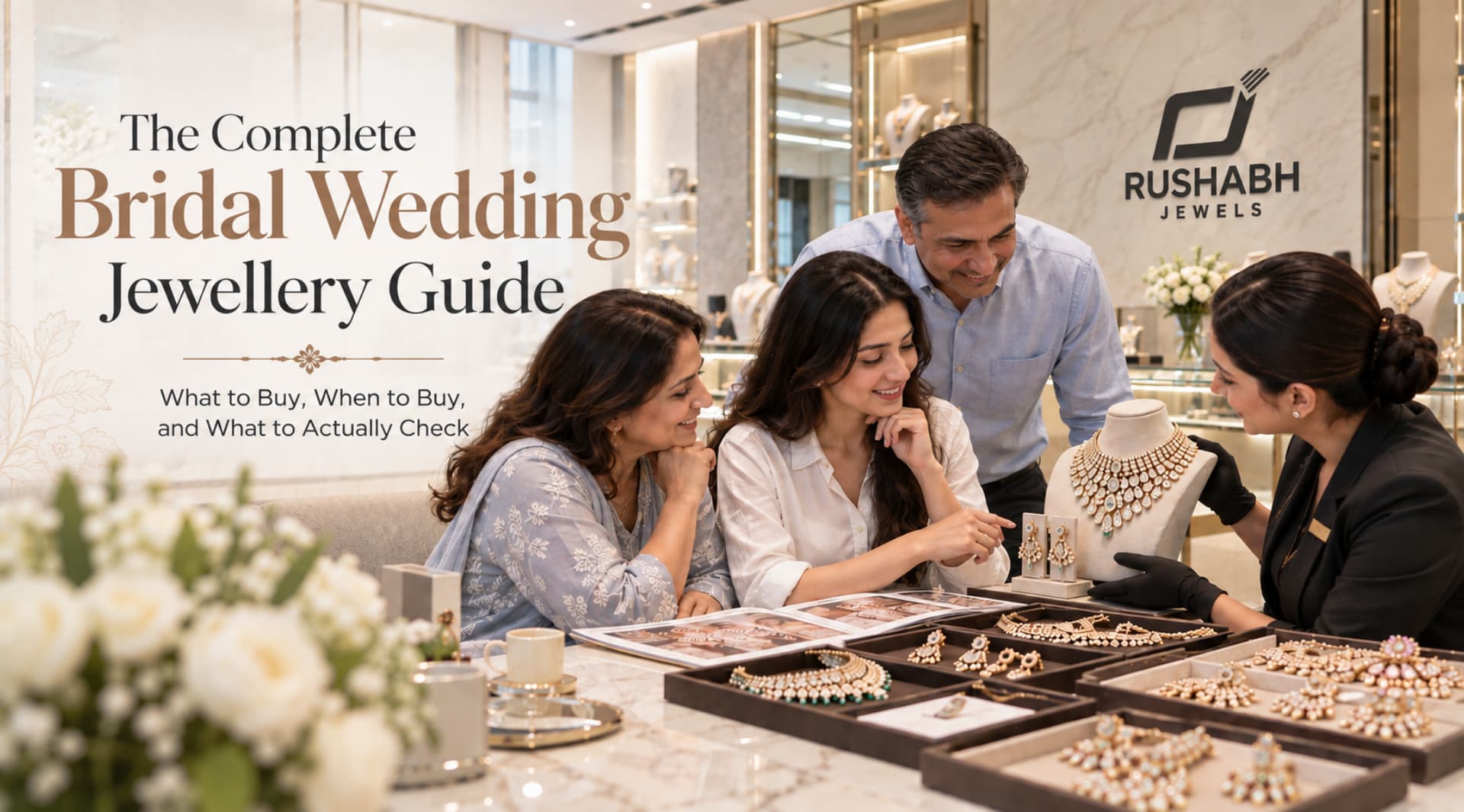
Most bridal jewellery guides tell you what looks beautiful. This one tries to tell you what is actually useful — what you need for each ceremony, how to think about budget across multiple functions, how a jewellery bill is supposed to read, and the three questions you should ask before anything Buy Bridal Wedding Jewellery Online.
We have been having these conversations with brides and their families at our Ahmedabad showroom for years. The same questions come up every wedding season — sometimes from families who have been through this before and want confirmation, more often from first-time brides who are navigating what can feel like a genuinely overwhelming process. This guide is an attempt to write down the answers we give in those conversations.
Start Here: The Six-Month Conversation You Should Be Having
The biggest mistake in bridal jewellery planning is starting too late. Not because good pieces will disappear — though popular designs do sell out in peak season — but because the decisions you make about jewellery are connected to decisions about the wedding outfit, the function dates, the budget, and sometimes what your in-laws are contributing to the trousseau. All of these need time to settle before you spend significant money.
Here is what a realistic planning timeline looks like:
Six Months Before — Set the Framework
Decide the approximate budget for jewellery across all ceremonies. Have the conversation about what is coming from the bride's family versus the in-laws. Broadly decide whether you want traditional gold, diamond, antique or a mix. This is not the time to buy — it is the time to stop guessing and start with actual numbers.
Four Months Before — Book a Consultation
Visit the jeweller with your wedding outfit — or at minimum, a photograph of the colour, fabric and embroidery style. Bridal jewellery should be chosen in response to the outfit, not independently. If you are ordering custom pieces, this is the last practical moment to get them made in time with any breathing room.
Three Months Before — Confirm and Pay
Finalise pieces for the wedding day and confirm any custom orders. Pay the advance. Get written confirmation of the delivery date, the agreed design, and the weight. This is also the time to buy pieces for pre-wedding functions if they have not already been decided.
One Month Before — Final Fitting
Try every piece together — with the actual outfit or as close to it as possible. Check that the necklace length works with the blouse neckline. Make sure the earrings do not pull on the ears after thirty minutes of wear. Check that bangles slide on comfortably — your hands swell slightly in hot weather. Any adjustments at this stage are manageable. Adjustments on the morning of the wedding are not.
Wedding Day — Just Wear It
Everything is confirmed, tried and comfortable. The goal on the wedding day is to feel at ease in your jewellery — not to be adjusting it, not to be worried about it. A piece that has been fitted, worn for a trial, and confirmed is the only kind that lets you forget it is there in the best possible way.
What You Actually Need — Ceremony by Ceremony
| Ceremony | Mood & Outfit | Jewellery Approach | Key Pieces |
|---|---|---|---|
| Haldi / Pithi | Outdoor, playful, yellow and festive | Minimal — turmeric and heavy gold do not mix well. Wear pieces you are comfortable getting marked or keep jewellery very simple. | Thin gold bangles, small floral studs, maybe a simple gold chain. No heavy necklace. |
| Mehendi | Afternoon, festive colours, relaxed | Light to medium — you will be sitting for the mehendi application and the pieces need to be comfortable for hours. No heavy kadas on the wrists being done. | Gold jhumkas or chandbalis, light gold necklace or pendant set, simple bangles on the arm not being hennaed. |
| Sangeet | Evening, festive, you will be dancing | Statement without being heavy — this is the function where you want pieces that catch light and photograph well. But you need to be able to move freely. | Chandbalis or long gold earrings, a layered necklace or statement haar, bangles that do not slide all the way up the arm when you raise hands to dance. |
| Wedding Ceremony | The main event — your heaviest look | Maximum — this is the one day for the complete bridal set. Weight matters less than comfort here because you are sitting for much of the ceremony. But pieces must stay in place during pheras. | Full necklace set or choker + haar layering, statement earrings, maang tikka, bangles and kadas, haath phool if traditional, mangalsutra at tying. |
| Reception | Evening party, modern or Indo-western | Polished and contemporary — many brides wear lighter, more modern pieces here. Diamond sets work beautifully. The reception is the function where you stand and talk to guests for hours — comfort matters more than weight. | Diamond necklace set or modern gold pendant set, sleek earrings, clean bangles. Avoid very heavy pieces if you will be on your feet for 4+ hours. |
Matching Jewellery to Your Wedding Outfit — The Real Rules
The standard advice is to match your jewellery to your outfit's colour and embroidery. That is partially right but misses the more important principle: the jewellery should create balance with the outfit, not mirror it. A heavily embroidered lehenga paired with equally heavy, ornate jewellery looks cluttered — the eye has nowhere to rest. A heavily embroidered lehenga paired with clean, bold gold pieces creates a visual conversation where each element has space to be appreciated.
Heavy Embroidered Lehenga
Choose jewellery with clean lines. A bold choker or polished kangan rather than intricate antique pieces. The embroidery is already doing the detailed work — the jewellery should be your counterpoint, not your match.
Minimal / Plain Lehenga
This is where elaborate jewellery earns its place. A heavily worked antique necklace, statement chandbalis, layered haar combinations — the clean fabric becomes the backdrop for the jewellery to be the focal point.
Silk or Banarasi Saree
The saree's texture and weave create their own visual richness. Pair with traditional gold — a classic haar, gold earrings, gold bangles. The warmth of 22KT gold against silk is a combination that has been working for centuries because it genuinely does.
Pastel / Light-Coloured Outfit
Light outfits open up every jewellery possibility. Diamond sets read particularly beautifully against pastels because the contrast is gentle. Gold also works — especially antique or polki designs where the surface texture creates depth against soft fabric.
Reception / Indo-Western Gown
Modern outfits call for modern jewellery. A diamond necklace in 18KT white gold, a structured choker, clean solitaire earrings. Avoid traditional heavy kangan or long rani haars with contemporary silhouettes — the visual clash is noticeable.
Red Traditional Bridal Lehenga
The classic — and it genuinely works. The deep red of a traditional bridal lehenga makes 22KT gold look more saturated. This is the outfit for your heaviest, most traditional jewellery. Full necklace sets, heavy bangles, maang tikka — everything earns its place here.
One practical suggestion: on your consultation visit, bring your outfit or a detailed photograph. Lay the jewellery pieces against the fabric under the store lighting before confirming. The combination you see in your mind and the combination you see in person can be quite different — especially with heavily embellished outfits where the stone work in the embroidery can either complement or compete with gemstones in the jewellery.
"The weight shown in the bill, the weight engraved on the hallmark, and the weight we show you on the scale when you visit — these three numbers should match. If any of them is different, ask until you understand why."
The Hallmark — Why It Is Not Optional
Every piece of gold jewellery purchased in India should carry a BIS Hallmark. This is not a preference or a recommendation — since 2021, it is mandatory for registered jewellers. The hallmark is the Bureau of Indian Standards' certification that the gold content of the piece matches what is declared.
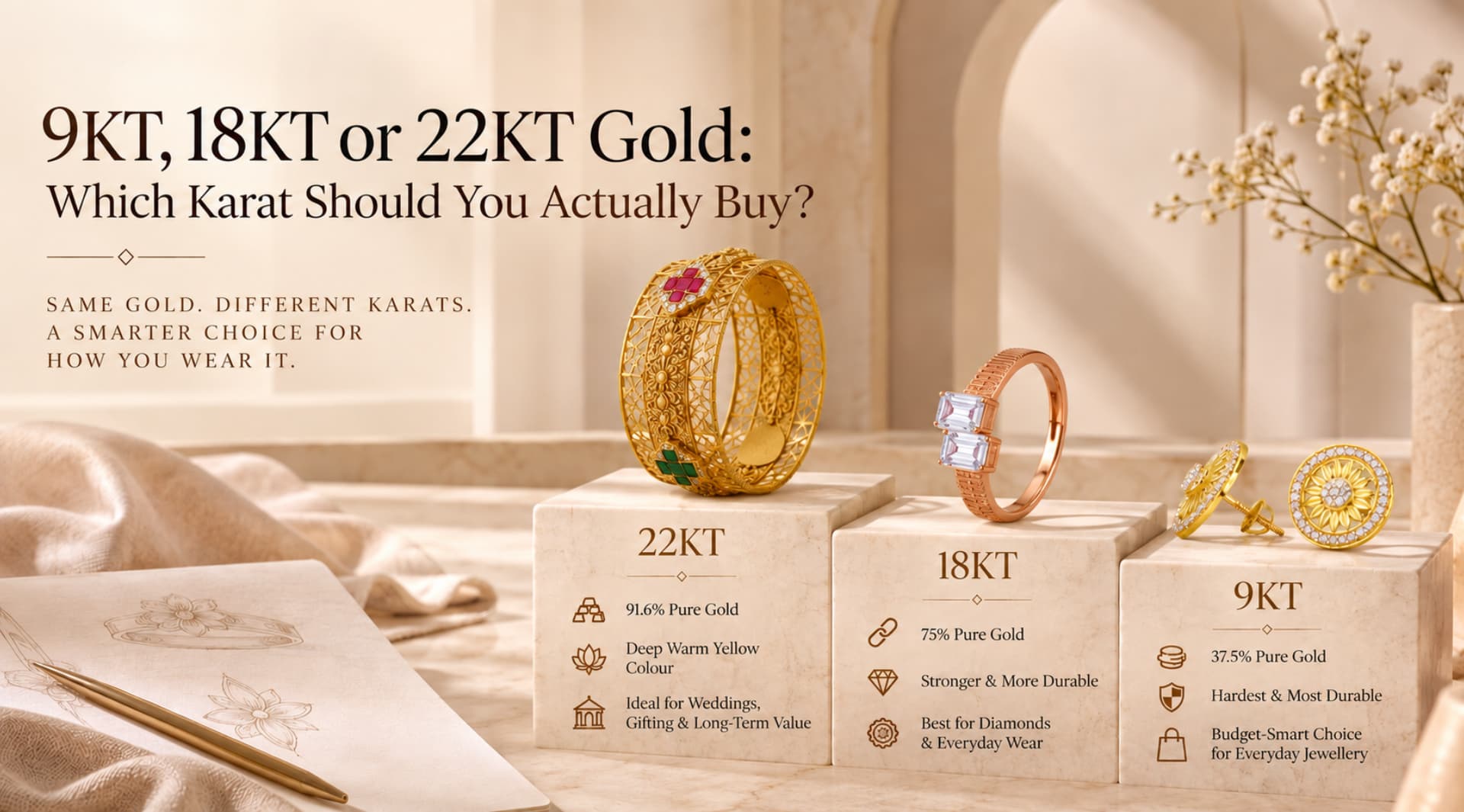
On a 22KT piece, the hallmark shows the number 916 — which is 91.6% pure gold. On 18KT, it shows 750. On 24KT, it shows 999. These numbers appear alongside the BIS logo, the testing centre's code, and the jeweller's unique identification. Each hallmark number is registered in the national BIS database, which means you can verify it independently.
Why does this matter for a bride specifically? Because bridal jewellery is often gifted from multiple sources — some from the bride's family, some from the in-laws, sometimes from relatives. Not all of these pieces will come from registered jewellers. A piece without a BIS hallmark has no independently verified gold content — which means if you ever want to exchange it, repair it, or understand its value, you are dependent entirely on the word of whoever sold it. A hallmarked piece carries its own evidence.
At Rushabh Jewels, every single piece in our bridal collection carries the BIS hallmark and comes with a certificate. This is non-negotiable regardless of the price point.
The Pre-Wedding Functions — A Simpler Approach
There is a tendency to treat every pre-wedding function as requiring a completely separate, fully planned jewellery outfit. This is partly encouraged by wedding content on social media, which makes it look like every ceremony requires a magazine-level look from head to toe.
In practice, the most comfortable approach for most brides is to focus the jewellery budget heavily on the wedding day and reception — the two occasions that are most photographed, most attended, and most permanent in your memory. For mehendi and sangeet, choose pieces that are beautiful but that you can also wear again: a good pair of gold jhumkas, a piece you will wear to family functions for the next decade. You are not wasting money on these — you are building a jewellery wardrobe that started with your wedding.
The pieces that genuinely should be chosen specifically for the wedding and not repurposed for daily wear are the very heavy ones — the full bridal necklace set, the haath phool, the heavy kadas. These are investment pieces and family heirlooms. Everything else can and should be chosen with post-wedding wearability in mind.
The Bridal Jewellery Checklist — What You Actually Need
Bridal Jewellery Checklist — Wedding Day Essentials
- ✓Necklace set — the centrepiece of the bridal look. Can be a single heavy necklace or a layered choker + haar combination. Choose based on blouse neckline.
- ✓Statement earrings — chandbalis, long chandelier jhumkas, or heavy drop earrings. Should be tried wearing for at least 30 minutes before the wedding to check for comfort.
- ✓Maang tikka — choose one that sits flush against the hairline without heavy pin pressure. The weight should be forward-balanced so it does not slide during pheras.
- ✓Bangles and kadas — sized properly and tried on before the wedding day. Note that hands swell in heat and during ceremonies — size accordingly.
- ✓Mangalsutra — for the tying ceremony. Ensure the length works with the neckline of the wedding blouse and that the chain is strong enough for daily wear afterward.
- ✓Nose ring / nath (if traditional) — confirm the fitting before the wedding. A nath worn for the first time on the wedding morning is a recipe for discomfort all day.
- ✓Haath phool / hand harness (if wearing) — measure the bride's hand specifically. These are made to order and standard sizes rarely fit perfectly.
- ✓Rings — engagement ring if applicable, and any wedding bands. Check sizing — the right-hand index or ring finger may be a different size from what was measured months earlier.
Three Questions Every Bride Should Ask Before Buying
These are not aggressive questions — they are reasonable questions that any honest jeweller should be able to answer immediately and without hesitation. If the answers are vague or the jeweller is uncomfortable, that tells you something useful.
First: What is the exact gold weight of this piece, and at what rate are you billing it today?
The weight should be visible on the piece's hallmark. The rate should match the day's 22KT or 18KT gold price. If a jeweller bundles the price without separating the gold component, you cannot verify whether the rate is fair.
Second: What is the making charge on this piece, stated as a percentage or flat amount?
Making charges should be declared. They are a legitimate cost — the craftsmanship has to be paid for. But they vary widely across jewellers and designs, and knowing the number lets you compare properly. A jeweller who refuses to separate making charges from gold value is making it impossible for you to understand what you are actually paying.
Third: Can I see the hallmark on this piece?
The BIS Hallmark should be visible to the naked eye or under a loupe. The purity number (916, 750, 999) should be there. If a jeweller says the hallmark is "inside" or "on the box" rather than on the piece itself, the certification does not exist in any meaningful form.
Plan Your Bridal Jewellery at Rushabh Jewels
Book a dedicated bridal consultation — in-store at Ellisbridge, Ahmedabad, or via video call from anywhere in India. We look at your outfit, your ceremonies and your budget before making a single suggestion.
Book a Consultation Explore Bridal Dreams CollectionA Final Thought on What Bridal Jewellery Is Actually For
There is a version of bridal jewellery planning that is entirely about how things look in photographs. That is understandable — wedding photographs are permanent and they matter. But the pieces you wear on your wedding day will outlast the photographs by decades. The necklace in your wedding album may be the same necklace your daughter wears to her first major function. The bangles may be passed to someone who never met you at your age but will carry something of your wedding day on their wrist.
This is why we have always thought of bridal jewellery as something closer to family history than fashion. The hallmark on the piece is not just a quality guarantee — it is a record of what it was made of and when it was made. The weight certificate is not just a billing document — it is the piece's story, preserved in writing.
Choose pieces that you would want to pass forward. Choose a jeweller who makes that possible by being honest about what you are Buy Bridal Wedding Jewellery Online. And give yourself enough time to choose without pressure — the decisions made in a hurry are rarely the ones you are proudest of years later.
Explore the Rushabh Jewels Bridal Collection
.jpg.jpeg&w=3840&q=75)
.jpg.jpeg&w=3840&q=75)