

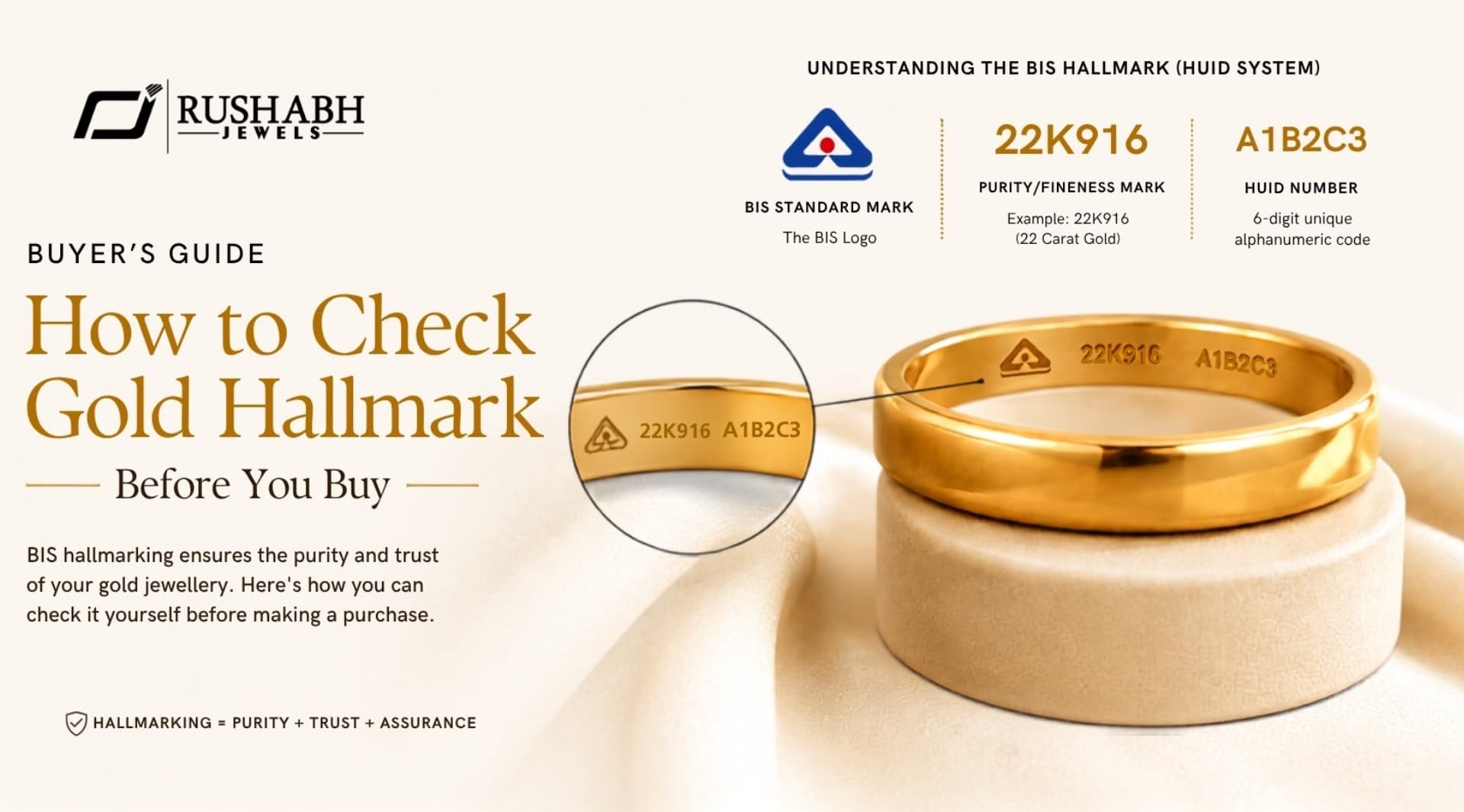
A lot of people walk into a jewellery store, see "916" stamped somewhere on the piece, and assume that settles it. It doesn't, really. That number alone tells you the gold is supposed to be 22 karat, but it doesn't confirm that the piece was actually tested, or that the jeweller stamping it is registered with BIS in the first place. Knowing the difference between a genuine hallmark and a printed number is what actually protects your money.
We get asked about this constantly at our CG Road, Ahmedabad store, so we put together a straightforward guide on what to look for, how to verify it yourself, and what to do if something doesn't add up.
What a Genuine BIS Hallmark Actually Looks Like
A properly hallmarked gold piece carries three marks, laser-engraved rather than printed:
- The BIS triangle logo — the Bureau of Indian Standards mark.
- The purity grade — 916 for 22K, 750 for 18K, 585 for 14K, and so on.
- The 6-digit HUID (Hallmark Unique Identification) code — an alphanumeric code unique to that exact piece.
If a piece is missing the HUID, it isn't hallmarked in the current system, no matter what the jeweller tells you. This applies across gold jewellery from 14K through 22K, and the framework has expanded over the past couple of years to bring in more purities and more districts, Ahmedabad included.
Why the HUID Matters More Than Anything Else on the Tag
Before HUID came in, two jewellers could both stamp "916 BIS" on their pieces, and there was no way for a buyer to independently confirm either claim. The HUID changed that. Every hallmarked piece is now traceable back to the exact assaying centre that tested it, which means the claim on your bill isn't just something you have to take on faith.
This is also why we'd tell you to check the HUID even at a store you already trust. It takes thirty seconds, and it's the one habit that protects you regardless of where you're buying from.
How to Verify a HUID Yourself, Step by Step
You don't need any special access for this. Here's what to do the moment you're handed a piece:
- Open the BIS CARE app (available for free on both Android and iOS) or go to the BIS hallmarking portal on a browser.
- Look for the "Verify HUID" option.
- Enter the 6-digit code engraved on your piece.
- Cross-check what comes up, the purity, the registered jeweller name, and the assaying centre, against what's written on your invoice.
If the HUID pulls up no result, or the details don't match your bill, that's a red flag worth raising on the spot, not after you've left the store.
What About Silver?
This one trips people up. Gold hallmarking has been mandatory for years now, but silver has followed a different path. It's still largely voluntary, though the rules around it have gotten noticeably stricter recently. Any silver piece that a jeweller does choose to hallmark now has to carry a HUID code as well, under the updated silver hallmarking standard. So the same rule applies: if a silver piece is hallmarked, verify it the same way you would gold. If it isn't hallmarked at all, that's not automatically a red flag for silver the way it would be for gold, but it does mean the purity claim rests entirely on the jeweller's word, so buy from someone whose reputation you actually trust.
Making Charges Aren't Part of the Hallmark
One thing worth clearing up while we're on the topic of the bill: hallmarking itself is not something you should be charged extra for beyond a small nominal fee, typically well under a hundred rupees per piece. If a store is bundling a large "certification charge" into your bill, ask for that line item to be broken down separately from making charges. The two are not the same thing, and they shouldn't be billed as if they are.
What to Do If You Spot a Problem
If the HUID doesn't verify, or a jeweller is reluctant to show it to you at all, you have real options. Complaints can be filed directly through the BIS CARE app, and selling non-hallmarked gold in mandatory areas carries actual penalties for the seller. You're not being difficult by asking these questions. You're doing exactly what the system was built for you to do.
A Note for Ahmedabad Shoppers Specifically
Ahmedabad's jewellery market, particularly around areas has no shortage of options, which is great for choice but also means purity practices vary more than buyers expect. A store's reputation and years in business count for something, but they shouldn't be the only thing you're relying on. Ask to see the HUID on the actual piece before it's packed, not just printed on the bill afterward. If you'd rather not do this standing at a counter with a queue behind you, booking an appointment ahead of time gives you the space to check everything unhurried.
The Short Version
Look for three marks: the BIS triangle, the purity number, and the 6-digit HUID. Verify the HUID yourself through the BIS CARE app before you finalize any purchase. Treat making charges and hallmarking fees as separate line items. And don't feel awkward about asking to see the hallmark up close, A transparent jeweller should be happy to explain the hallmark and purity details before you complete your purchase.
That's really all there is to it. The system exists so you don't have to take anyone's word for it, so use it.