For decades, buying gold jewellery in India came down to one question: 22 carat or 18 carat? That list just got longer. Since July 2025, 9 carat gold has been part of the BIS hallmarking system, and large jewellers have started putting 9 carat designs in their cases. If you’ve seen a piece with a very friendly price tag and a “375” stamped on it, that’s what you were looking at.
So is it a clever way to get gold jewellery without stretching your budget, or is it a compromise dressed up as a bargain? Our honest answer is: it depends on what you want the piece to do.
What 9 carat actually is
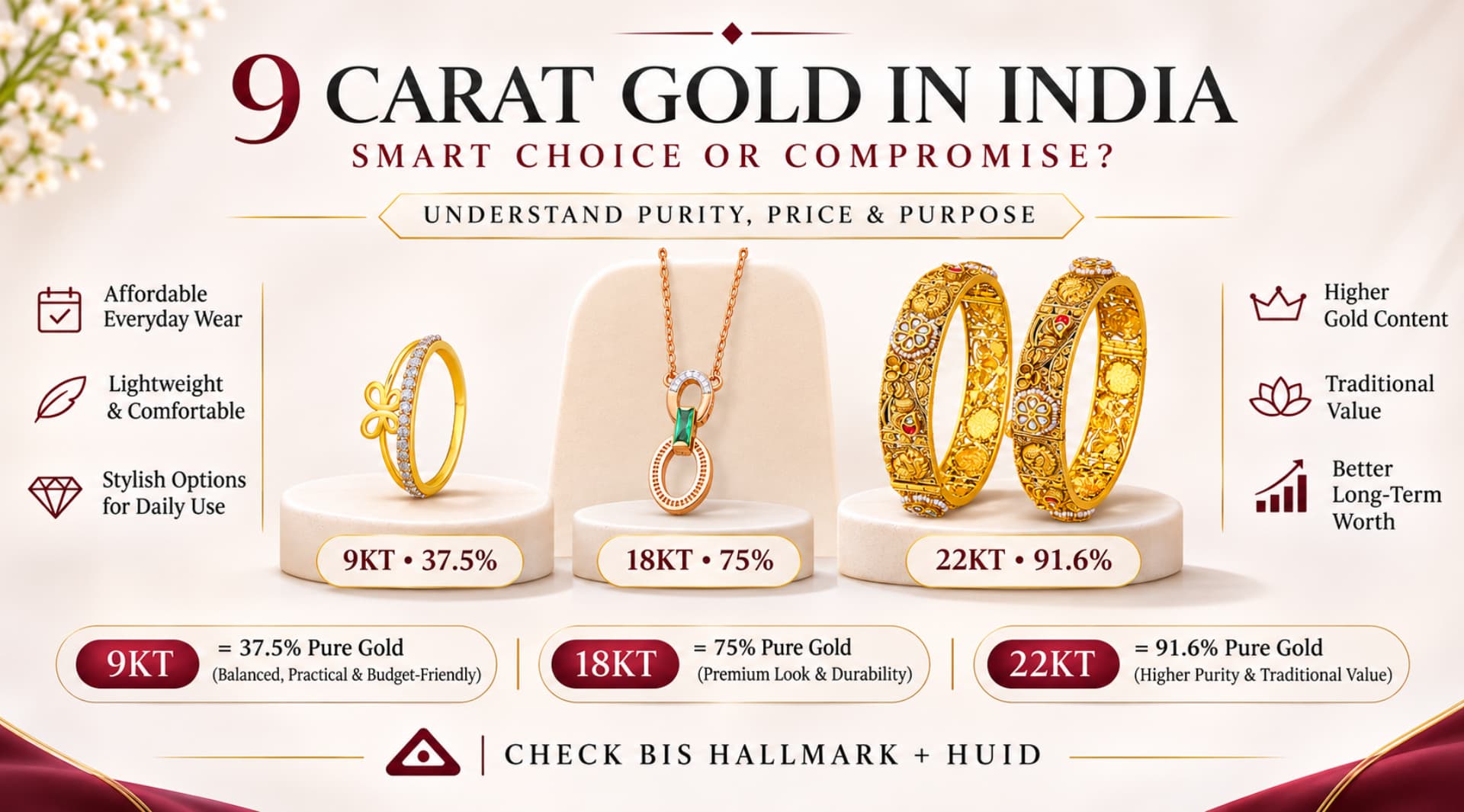
Only 37.5% of 9 carat gold is pure gold. The rest, a bit under two thirds, is other metals. For comparison, 18 carat is 75% gold and 22 carat is about 91.6%. The BIS hallmark for 9 carat shows 375, in the same way 916 marks 22 carat and 750 marks 18 carat. If you want a refresher on how the other numbers work, our post on 22 carat vs 24 carat vs 18 carat gold covers it.
| Carat | Pure gold | Hallmark |
|---|---|---|
| 22K | about 91.6% | 916 |
| 18K | 75% | 750 |
| 14K | about 58.5% | 585 |
| 9K | 37.5% | 375 |
Why it’s suddenly everywhere
The reason is simple and it isn’t about fashion. Gold prices have climbed so high that a lot of people are priced out of the jewellery they’d have bought a few years ago. Jewellers noticed, and lower carat pieces give them something to sell at a price a first-time or younger buyer can say yes to. Hallmarking made it respectable. Before the rule change, there was no official certification for 9 carat, so buyers had to take the seller’s word.
Where 9 carat makes sense
It works best for things you’ll wear and enjoy, not things you plan to hold. A light everyday pendant, a pair of studs, a trendy ring you might want to change in two years, a gift for a teenager or a young colleague. In those cases you’re paying for a design, not parking money, and a lower price makes perfect sense.
The extra alloy also makes the metal harder, so thin, delicate designs can hold their shape better than they would in higher carat gold.
Where it falls short
Here’s the part that sales pitches skip. If you’re buying gold partly as savings, 9 carat is a weak fit. When you sell or exchange it later, what counts is the actual gold content, and there’s only 37.5% of it in each gram. The making charges you paid for the design don’t come back. On a cheap piece that’s a small amount. On a heavily worked piece it can be a big share of what you spent.
There’s also the matter of the other metals. Because they make up most of the piece, colour can look paler, and some people find that certain alloy metals irritate their skin. If you have sensitive skin, ask what the alloy contains before buying.
And if you’re buying for a wedding or a milestone where tradition matters, most families will still reach for 22 carat. It’s what people recognise, it holds value better, and it looks the part.
Our honest take
Think of 9 carat as jewellery first and gold second. It’s a fair way to wear something real and hallmarked without a large bill. It is not a replacement for gold you intend to keep, pass down or exchange. If someone offers it to you as an investment, walk away.
If you’re ever unsure which carat suits your purpose, it helps to look at pieces side by side. You can book an appointment and we’ll go through it with you, or browse our Buy gold bangles and Buy gold necklaces first. Always check the BIS hallmark and HUID before you pay, which our post on how to check gold hallmark and HUID explains step by step, and compare the day’s rate on Today’s Gold Rate. Our post on how gold jewellery price is calculated will also help you read the bill.