Open any online jewellery listing and you’ll find two necklaces that look nearly identical. One costs a few hundred rupees. The other costs a few lakhs. Both say “gold” somewhere in the description, and both shine in the photo. The gap is real, and it comes from what sits under the shine.
Gold plated
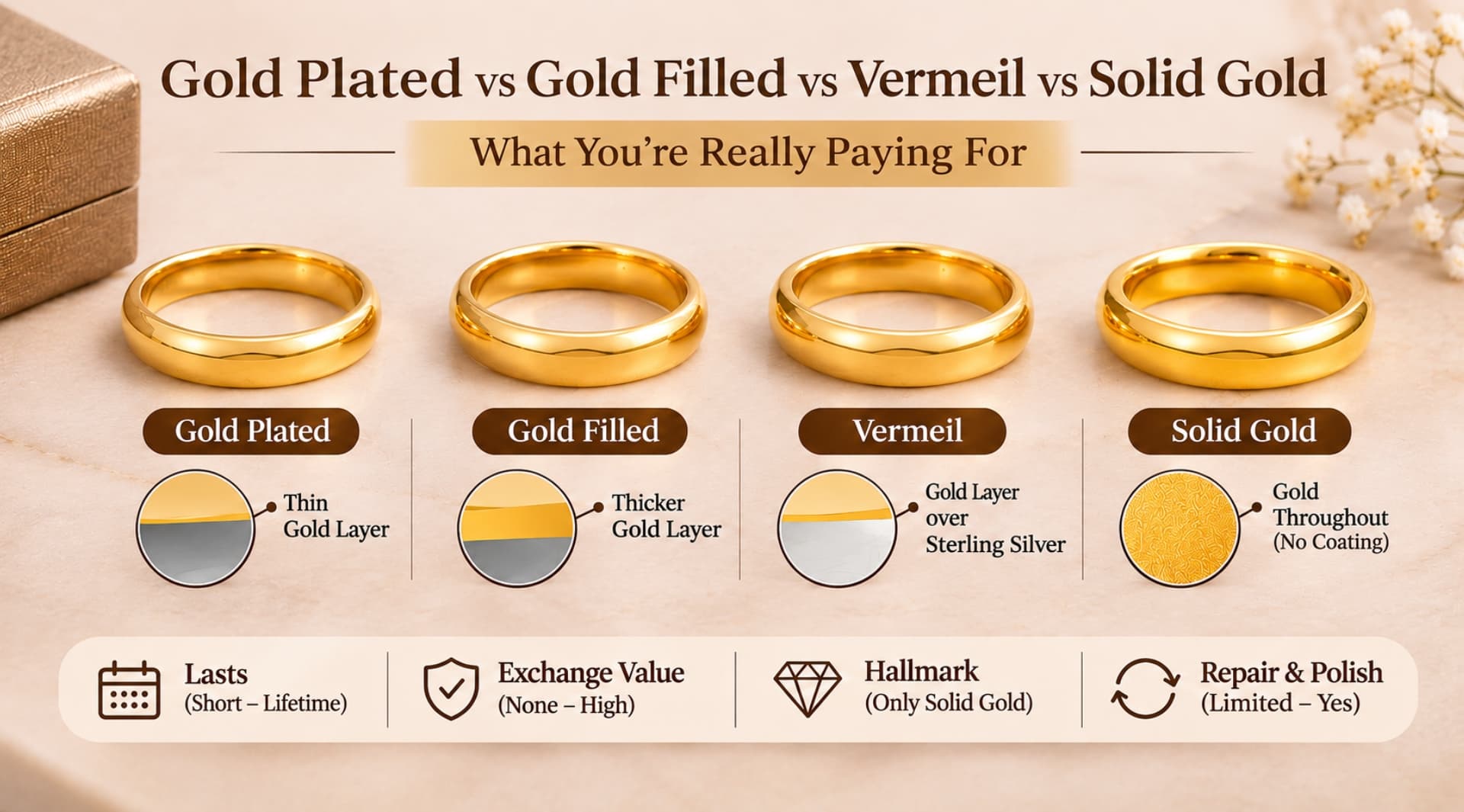
A plated piece is a base metal, usually brass or copper, with a very thin film of gold on the outside. There is hardly any gold in it, which is exactly why it’s cheap. Sweat, perfume and daily rubbing wear that film down, and the metal underneath starts to show, sometimes with a green mark on the skin. Plated jewellery makes sense for a wedding function or a trend you’ll get bored of. It just isn’t an investment, and nobody should sell it to you as one.
Gold filled
Here the gold layer is much thicker and is bonded to the base metal with heat and pressure. It survives far longer than plating. The catch is that the rules for what can be called gold filled differ from country to country, so the label alone doesn’t tell you much. Ask what the layer is made of and how thick it is. A seller who knows will answer easily.
Vermeil
Vermeil usually means a gold layer over sterling silver, not over a cheap base metal. Silver is a better foundation, and the piece feels more refined, but the gold on top is still a coating, and coatings wear. Definitions also vary between markets, so one seller’s vermeil may not match another’s.
Solid gold
This is gold all the way through, mixed with a little other metal only to make it strong enough to wear. Scratch it and you find gold underneath. Polish it and the shine comes back, because there’s no thin layer to lose. It’s also the only one of the four that can carry a BIS hallmark with a purity grade and a HUID, which is how you confirm what you’ve bought. If you want to know what those purity numbers mean, we explain it in our post on 22 carat vs 24 carat vs 18 carat gold.
Quick comparison
| Gold plated | Gold filled | Vermeil | Solid gold | |
|---|---|---|---|---|
| What it is | Thin gold layer over base metal | Thicker gold layer bonded to base metal | Gold layer over sterling silver | Gold throughout |
| Lasts | Short | Medium | Medium | Lifetime and beyond |
| Can be repaired or polished | Limited | Limited | Limited | Yes |
| Exchange value | None as gold | Very little | Very little | High, based on gold content |
| Hallmark | Not as gold | Not as gold | Not as gold | BIS hallmark and HUID |
Why the prices are so far apart
You’re paying for different things. With solid gold, most of the price is the metal itself, which keeps its value and can be exchanged later at a rate tied to its gold content. With plated or filled pieces, you’re mostly paying for design, branding and a small amount of gold that can’t be recovered in any practical way. So the cheaper piece isn’t a bargain version of the expensive one. It’s a different product.
Which one to buy
For something you’ll wear a handful of times, plated is fine, as long as you know what it is. For a few good years of daily wear on a tighter budget, filled or vermeil can work if the seller is honest about the layers. For anything you want to repair, pass down or sell one day, only solid gold does that job.
One last thing. “Gold tone”, “gold finish”, “gold look” and “golden” are colour descriptions, not metal descriptions. Look for the word solid, and look for the hallmark.
If you want to feel the difference in your hand, book an appointment and we’ll set pieces side by side. You can also browse our Buy gold necklaces, gold bangles and gold kada, and check Today’s Gold Rate before you buy.