Somewhere in your home there's probably a chain you stopped wearing, a bangle from a relative that doesn't suit you, or a set from twenty years ago that's too heavy for today's taste. Every year around Dhanteras, a lot of families in Ahmedabad finally decide to turn that old gold into something they'll actually wear.
It's a smart move. It's also the moment where people most often walk away unsure whether they got a fair deal, because nobody explained how the value was worked out. So here's the whole process, laid out plainly, before you carry anything to a counter.
How Old Gold Is Actually Valued
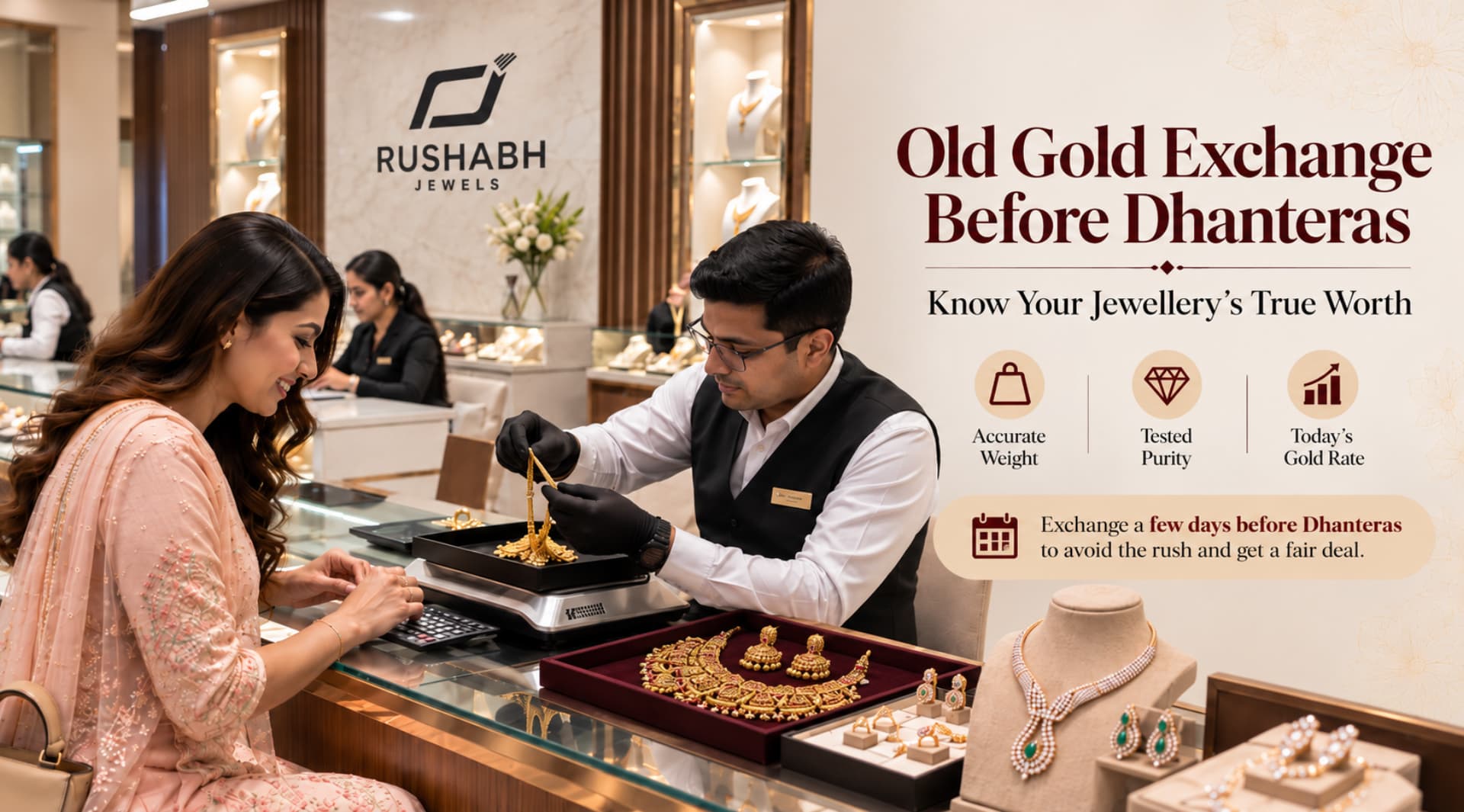
The value of your old piece comes down to three things: how much it weighs, how pure it really is, and the gold rate on the day you exchange it.
Purity is the part people skip. A piece sold as 22 karat decades ago may not test as 22 karat today, and older jewellery especially can vary. The shop doesn't guess. They test it, and the tested purity decides the number you're paid for.
Then comes the deduction. Melting old jewellery isn't free, and most jewellers subtract a small percentage for it. That percentage differs from shop to shop, which is why it's worth asking about directly before anything is weighed.
A Quick Worked Example
Say you have an old chain that weighs 10 grams and tests as 22 karat. For the sake of the maths, take today's 22 karat rate of 13,014 rupees a gram. The rate moves every day, so check the real figure on the day you exchange.
Ten grams at that rate comes to 1,30,140 rupees. If the shop deducts 3 percent for melting, that's 3,904 rupees off, leaving 1,26,236 rupees of exchange value to put toward new jewellery.
If the same chain tested a little below 22 karat, the value drops proportionally. That's not a trick, it's simply what the testing is for. What matters is that you see the test result and the working, not just a final figure.
Stones, Enamel and Other Things That Get Subtracted
If your old piece has stones, the stone weight isn't gold, so it's taken off the weight before the calculation. Same for lac or filling inside hollow pieces, and sometimes for enamel work. A bangle that weighs 40 grams on the scale may hold noticeably less actual gold.
This is perfectly normal, but it's another reason to ask for a breakdown. A fair jeweller will show you gross weight, deductions and net gold weight as separate lines.
Exchange or Sell: They Are Not the Same Thing
When you exchange, the value of your old gold is adjusted against a new purchase. When you sell, you take the money. The two can be treated differently by a jeweller, so ask which applies to you and what rate each uses.
Also ask whether making charges and GST apply on the new piece in full, since your old gold covers the metal value but the new jewellery still carries its own charges. Selling for cash may also have tax implications depending on how long you've held the gold and how much you gain, so if the amount is large, a quick word with your CA is sensible.
What to Bring and What to Ask
Carry your ID and, if you have it, the original bill. Old bills help when a piece's purity is in question, though most shops can test without one.
Then ask these before you hand anything over.
Will you test the purity in front of me, and can I see the result? How much do you deduct for melting? Is the exchange based on today's rate, and is it the same rate you'd charge me for new gold? Can I get the full calculation written on a slip?
A jeweller who's comfortable answering is usually one you can trust with the rest of the deal.
Timing: Don't Leave It to Dhanteras Evening
Dhanteras falls on 6 November this year, and the days around it are among the busiest of the year in every jewellery store. Counters are crowded, testing queues are longer, and the people serving you are rushed, which is exactly when mistakes and misunderstandings happen.
If you can, exchange a few days earlier, then pick up your new piece on the auspicious day itself. You get the same festive purchase with far less pressure.
Don't Forget to Check the New Piece Too
Once the old gold is settled, the new jewellery still needs the same scrutiny as any purchase. Look for the BIS hallmark and the HUID on the piece itself, and verify it on the BIS CARE app before you pay. We've covered exactly how to do that in our hallmark checking guide.
Exchanging Old Gold in Ahmedabad
You can check the day's rate on our gold rate page before you come in, so you already know roughly what to expect. Visit our Ellisbridge store, ask for the testing and the full calculation, and take your time. If you'd rather avoid the pre-Dhanteras rush, you can also book an appointment and come at a quieter hour.
The Short Version
Your old gold is valued on weight, tested purity and the day's rate, minus a small melting deduction and anything that isn't gold. Ask to see the test, ask for the working in writing, and know whether you're exchanging or selling. Go a few days before Dhanteras if you can. And whatever you buy with the proceeds, verify the hallmark before you pay.